
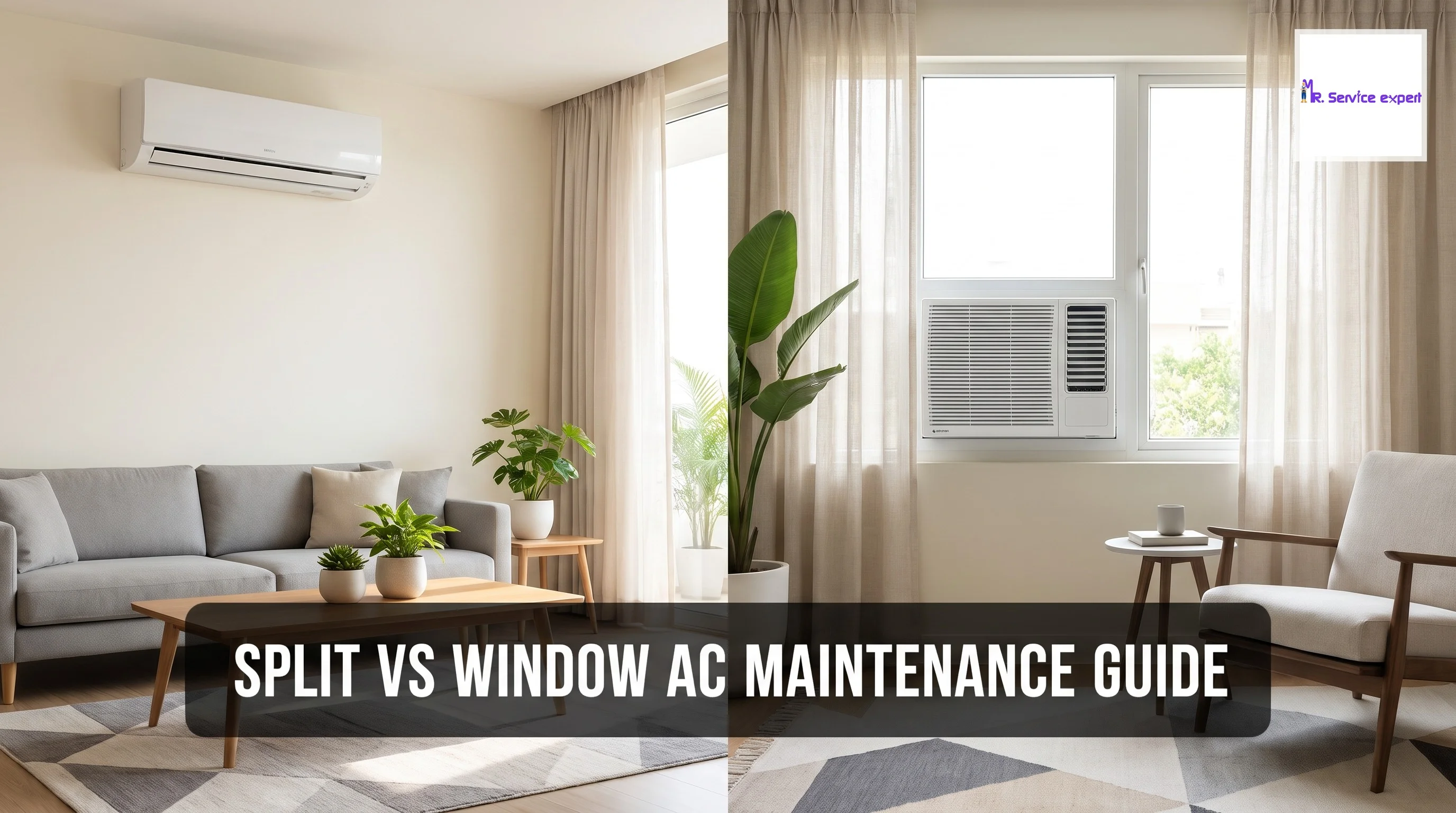
Split AC vs Window AC: Maintenance Differences
When the scorching Indian summer arrives, air conditioners become our best friends. But have you ever wondered why your neighbor seems to call the AC technician more often than you do, despite having what looks like a similar cooling setup? The answer often lies in the type of AC they own and how it needs to be maintained. Understanding the maintenance differences between split AC and window AC units can save you thousands of rupees annually and keep your home comfortably cool without unexpected breakdowns.
Split AC maintenance and window AC maintenance differ significantly in complexity, cost, and frequency. While both systems serve the same purpose of cooling your space, their design, installation, and operational mechanisms create entirely different maintenance requirements. Making an informed choice between these two popular cooling systems requires understanding not just their cooling capabilities but also the long-term commitment to keeping them running efficiently. In India, where power consumption and service costs matter deeply to household budgets, this knowledge becomes even more critical.
This comprehensive guide explores every aspect of maintaining split and window air conditioners. Whether you are planning to purchase a new AC or already own one and want to optimize its performance, understanding these maintenance differences will help you make smarter decisions. From cleaning routines and filter replacements to professional servicing needs and common problems, we will cover everything you need to know. The maintenance approach you choose directly impacts your electricity bills, equipment lifespan, and indoor air quality.
The Indian climate poses unique challenges for air conditioning systems. Dust, humidity, and extended usage periods mean that regular maintenance becomes non-negotiable rather than optional. Many homeowners discover too late that neglecting routine maintenance leads to expensive repairs, reduced cooling efficiency, and even complete system failures during peak summer months when you need your AC the most. By understanding the specific maintenance needs of your AC type, you can prevent these issues before they occur.
Let us dive deep into the world of split AC maintenance versus window AC maintenance, examining every factor that affects your cooling comfort, wallet, and peace of mind. This AC comparison will equip you with practical knowledge to maintain your cooling system effectively throughout the year.
Design Differences That Impact Maintenance
The fundamental design difference between split and window ACs creates distinct maintenance requirements. Split air conditioners consist of two separate units: an indoor unit containing the evaporator coil and blower, and an outdoor unit housing the compressor and condenser. These components are connected through refrigerant pipes and electrical wiring. This separation means split AC maintenance requires attention to multiple locations, both inside and outside your home.
Window ACs, conversely, house all components in a single compact unit installed in a window or wall opening. Everything from the compressor to the cooling coils sits in one box. This unified design simplifies access for maintenance but also means any servicing work might temporarily disrupt your installation. The compact nature makes some internal components harder to reach without complete removal.
Split systems typically require more complex installation, involving drilling holes through walls for piping and drainage. This creates additional maintenance points like checking pipe insulation, ensuring proper drainage function, and monitoring refrigerant levels. The outdoor unit, often exposed to weather elements, dust, and pollution, needs regular cleaning to maintain optimal heat exchange. The indoor unit, mounted high on walls, requires ladders or stools for routine cleaning, making DIY maintenance slightly challenging.
Window AC units sit partially outside, directly exposed to outdoor conditions while remaining accessible from inside. This positioning means easier DIY maintenance access but also greater exposure to dust, rain, and environmental factors. The single-unit design means that when one component fails, the entire system might need attention, whereas split systems sometimes allow isolated component repairs.
Understanding these design differences helps explain why split AC maintenance typically costs more per service visit but may require less frequent professional intervention compared to window AC maintenance, which while simpler, often needs more regular attention due to higher exposure to environmental factors.
Cleaning Requirements and Frequency
Filter cleaning represents the most crucial regular maintenance task for both systems, yet the process differs substantially. Split AC maintenance involves cleaning two separate filters in the indoor unit, typically located behind a removable front panel. These filters accumulate dust, pollen, and airborne particles. Manufacturers recommend cleaning these filters every two weeks during heavy usage periods and monthly during moderate use. The process involves removing the panel, extracting filters, washing them with mild detergent, drying completely, and reinstalling.
Window AC maintenance requires cleaning a single filter that usually slides out from the front grille. This filter tends to accumulate dirt faster because the unit draws air directly from the room and outside environment simultaneously. Weekly cleaning during peak summer months proves necessary for optimal performance. The simpler access point makes this a quicker task, taking just five to ten minutes compared to fifteen to twenty minutes for split AC filter maintenance.
Beyond filters, split systems need regular cleaning of the indoor evaporator coils, outdoor condenser coils, and the drain pan. The indoor coil cleaning requires careful handling to avoid damaging delicate fins. Many homeowners prefer professional AC repair service for this task annually. The outdoor unit collects significant dirt, leaves, and debris, requiring quarterly cleaning in dusty Indian environments. You can rinse the outdoor coils with a gentle water spray, but avoid high pressure that might bend the aluminum fins.
Window AC units require cleaning of both evaporator and condenser coils, which sit back-to-back in the same chassis. Accessing these often means partially or fully removing the unit from its installation. This makes thorough cleaning more disruptive but ensures all components receive attention simultaneously. The condensate drainage system in window units also needs regular checking to prevent water backup and potential leakage inside your room.
The drain line in split ACs deserves special attention. Blocked drains cause water leakage from the indoor unit, damaging walls and creating health hazards. Flushing the drain pipe with a vinegar-water solution every three months prevents algae and mold buildup. Window units typically have simpler drainage through a small hole at the base, requiring only periodic checking to ensure it remains unobstructed.
Professional Servicing Needs
Professional servicing requirements differ dramatically between these systems. Split AC maintenance typically demands annual comprehensive servicing by trained technicians. This service includes refrigerant level checking, pressure testing, electrical connection inspection, thermostat calibration, and deep cleaning of both units. The complexity of split systems means that specialized tools like manifold gauges, vacuum pumps, and refrigerant recovery equipment become necessary for proper maintenance.
The service cost for split ACs in India ranges from INR 500 to INR 1500 for routine annual maintenance, depending on your location and AC capacity. More extensive services involving gas refilling, component replacement, or AC repairing work can cost INR 2000 to INR 5000. The two-unit design means technicians spend more time traveling between indoor and outdoor units, increasing labor costs.
Window AC maintenance services generally cost less, ranging from INR 400 to INR 1000 for comprehensive annual servicing. The single-unit accessibility reduces service time. However, window units often require more frequent professional attention, especially in dusty environments or areas with high pollution. Many AC installation service providers recommend bi-annual servicing for window units in metropolitan areas where air quality remains poor.
Split systems benefit from remote diagnostics capabilities in modern models. Many newer split ACs feature error code displays that help technicians quickly identify problems without extensive troubleshooting. This reduces service time and costs. Window units typically lack such sophisticated diagnostic features, requiring more manual inspection to identify issues.
Gas leakage represents a common concern in both systems but manifests differently. Split AC maintenance includes checking multiple connection points, joints, and the longer refrigerant piping for potential leaks. Window units have fewer leak points but their compact design sometimes makes leak detection and repair more challenging. Refrigerant refilling for split ACs costs approximately INR 2000 to INR 3500, while window AC gas refilling ranges from INR 1500 to INR 2500.
Common Maintenance Issues and Solutions
Understanding typical problems helps prevent costly breakdowns. Split AC maintenance frequently addresses issues like water leakage from the indoor unit, a problem rarely seen in window ACs. Blocked drain pipes, improper installation slope, or frozen evaporator coils cause this leakage. Regular drain cleaning and ensuring proper unit leveling during installation prevents these issues. When your split AC leaks water, check the drain pipe first before calling for professional help.
Window units commonly face issues with AC not cooling properly due to inadequate airflow. The compact design means that blocked filters or dirty coils immediately impact performance. Unusual noises from compressor operation also occur more frequently in window ACs because all mechanical components sit in one housing near your living space. Regular cleaning and ensuring proper installation tightness reduces vibration-related noise.
Remote control malfunctions affect split ACs more often since they rely entirely on remote operation. Battery replacement, sensor cleaning, and ensuring no obstructions between the remote and indoor unit resolve most issues. Window units with manual controls face fewer such problems but their control panels, exposed to more environmental factors, sometimes require replacement sooner.
Both systems can experience frozen coils, but the causes differ slightly. In split AC maintenance, frozen coils often result from refrigerant issues, blocked filters, or inadequate airflow. Window AC coils freeze more commonly due to running the unit at maximum cooling in moderate temperatures or restricted airflow. Turning off the AC and letting coils thaw completely, then addressing the underlying cause, resolves this issue.
Electrical problems occur in both types but require different troubleshooting approaches. Split systems have separate electrical connections for indoor and outdoor units, plus the control wiring between them. Checking all these connection points becomes necessary during repair work. Window units have simpler wiring but their exposure to moisture sometimes causes electrical component corrosion, requiring more frequent electrical inspections.
Cost Comparison Over Time
Analyzing total maintenance costs over a typical AC lifespan reveals important insights. Split AC maintenance costs appear higher per service visit, but the annual total often remains competitive with window units when you factor in frequency. A split AC might need one comprehensive professional service annually costing INR 1200, plus four DIY filter cleanings. Window AC maintenance might require two professional services yearly at INR 800 each, plus more frequent filter cleaning due to faster dirt accumulation.
| Maintenance Aspect | Split AC (Annual Cost) | Window AC (Annual Cost) |
|---|---|---|
| Professional Service | INR 1000-1500 (once) | INR 800-1000 (twice) |
| Filter Cleaning | DIY - Minimal cost | DIY - Minimal cost |
| Deep Cleaning | Included in service | Included in service |
| Gas Refilling (if needed) | INR 2500-3500 | INR 1800-2500 |
| Spare Parts (average) | INR 800-1500 | INR 600-1200 |
| Total Annual Average | INR 2000-3000 | INR 2200-3400 |
Energy efficiency maintenance impacts long-term costs significantly. Well-maintained split ACs typically maintain better efficiency over time because their components operate in more controlled environments. The outdoor unit, though exposed, contains robust components designed for outdoor use. Window units, with all components in one stressed chassis, sometimes experience efficiency degradation faster, increasing electricity costs.
Component lifespan differences also affect overall maintenance economics. Split AC compressors, operating in dedicated outdoor units with better heat dissipation, often last longer than window AC compressors packed in tight spaces. However, when major split AC components fail, replacement costs run higher. A split AC compressor replacement costs INR 8000 to INR 15000, while window AC compressor replacement ranges from INR 6000 to INR 10000.
The installation quality significantly impacts maintenance costs for both systems. Professional installation ensures proper positioning, secure mounting, correct refrigerant charging, and optimal drainage setup. Poor installation leads to recurring problems, frequent service calls, and shortened equipment life. Investing in quality installation saves considerably on long-term maintenance expenses.
DIY Maintenance Capabilities
Homeowner-performed maintenance differs substantially between these systems. Split AC maintenance allows several effective DIY tasks that keep the system running efficiently between professional services. Filter removal and cleaning takes minimal skill. Most manufacturers design filters for easy access, with clear instructions in user manuals. Regular vacuuming of the indoor unit's exterior and ensuring no furniture blocks airflow also helps maintain performance.
The outdoor unit of split ACs benefits from periodic inspection and gentle cleaning. You can remove leaves, check for insect nests, and carefully rinse the condenser coils with a garden hose on low pressure. However, avoid high-pressure washing that damages fins. Keeping the area around the outdoor unit clear ensures proper airflow and heat dissipation. These simple tasks prevent many common problems and reduce professional service needs.
Window AC maintenance offers more comprehensive DIY possibilities because of single-unit accessibility. Beyond filter cleaning, homeowners can remove the front panel, vacuum internal components, check drainage, and even perform basic coil cleaning. Online tutorials and manufacturer guides make these tasks approachable for average homeowners. However, complete unit removal for thorough cleaning requires care to avoid damaging the installation or dropping the heavy unit.
Safety considerations matter greatly in DIY maintenance. Always disconnect power before cleaning any AC components. For split systems, turn off both the indoor unit and the outdoor unit circuit breakers. When working with the outdoor unit, ensure stable footing and avoid touching electrical components. For window units, secure the chassis properly before removing front panels to prevent accidental falls.
Both systems benefit from simple seasonal maintenance routines. Before summer begins, thorough cleaning, filter replacement, and test running ensure readiness. During peak usage, weekly filter checks and monthly drain inspections prevent mid-season breakdowns. Post-monsoon cleaning removes accumulated moisture and prevents mold growth. These proactive DIY steps significantly reduce the need for emergency service calls.
Long-Term Durability and Maintenance Planning
Understanding lifespan expectations helps plan maintenance budgets. Split ACs typically last twelve to fifteen years with proper maintenance, while window units average eight to twelve years. This difference reflects design advantages where split system components operate in more favorable conditions. The outdoor unit's robust construction withstands weather better than the partially exposed window unit chassis.
Creating a maintenance schedule ensures consistent care. For split AC maintenance, mark your calendar for monthly filter cleaning during summer, quarterly outdoor unit inspection, and annual professional servicing before peak season. Document refrigerant pressure readings, service dates, and any repairs to track system health over time. This record helps technicians diagnose recurring issues and plan preventive measures.
Window AC maintenance schedules should include bi-weekly filter cleaning during heavy use, monthly complete unit inspection, and professional servicing at the start and end of summer. In coastal areas with high humidity and salt air, increase inspection frequency to monthly even during winter storage periods. Corrosion develops faster in these environments, requiring more vigilant maintenance.
Warranty coverage affects maintenance planning. Most split ACs come with five-year compressor warranties and one to two years comprehensive coverage. Maintaining service records and using authorized services ensures warranty validity. Window units typically offer one to three year warranties on compressors. Unauthorized modifications or service void these warranties, making professional maintenance essential during warranty periods.
Planning for eventual replacement involves tracking repair frequency and costs. When annual maintenance and repair expenses exceed thirty percent of a new unit's cost, replacement becomes economically sensible. Split systems justify higher repair investments due to their longer lifespan potential. Window units, with shorter expected lives and lower replacement costs, often make less economic sense to extensively repair once they exceed eight years of age.
Environmental and Location Factors
Indian environmental conditions dramatically impact maintenance needs. In cities like Delhi, Bangalore, and Mumbai, high pollution levels mean split AC outdoor units accumulate dirt rapidly. Monthly cleaning of outdoor coils becomes necessary compared to quarterly cleaning in less polluted areas. Window units face similar challenges but their single-unit design means the entire system gets exposed to these harsh conditions simultaneously.